
Who Is Paradise For? A Conversation with Multimedia Artist Jo Cosme

Artist Jo Cosme grew up being told Puerto Rico was paradise. Her work asks who that story actually belongs to.

Yolanda Cosme grew up in Borikén, the indigenous name for the island the Spanish renamed Puerto Rico, absorbing a story about herself that wasn't hers. It was the story colonialism tells: that North Americans are more educated, more intellectual, more worthy. That to be from the Caribbean is to be lesser. "We grew up with this shame of being savages," she says. "That's what they tell us and we grow up having that internalized."
Jo, as she goes by, didn't find her way out of that story through a class or a book. Slowly, through conversations with people studying humanitarian issues, through moving to Seattle, through seeing the gap between how Puerto Ricans understand themselves and how they're seen from the outside, she started to unlearn it. "The more I started having conversations with people, I started getting more and more radicalized, realizing how deeply brainwashed a lot of us are…You're just taught that the U.S. is going to save you, that statehood is going to save you."

Now she makes art to bring awareness to it. She describes herself less as an artist and more as a storyteller. "Maybe I'm just having insecurities about the title artist," she says with a laugh, but her work is unmistakably political. Her recent pieces center on a single question that sounds simple until you sit with it: what is paradise? "What does that mean? Why is that title given to certain aesthetics? I even have that image myself but I know it's implanted by the colonizer gaze of the land. And I happen to be from a place that is called [paradise]."
Puerto Rico has been marketed as paradise for as long as Jo can remember. The beaches, the sunsets, the warmth, all packaged and sold to tourists. Her work asks who that framing actually serves and at whose expense. "Who is it for? Why does the native population of a place never get to call or see it that way?"
She traces that question through 500 years of colonialism, from Spanish rule to what she calls the very tangible, very ongoing reality of American colonialism today. When she first arrived in Seattle, she noticed that the word "colonialism" was mostly used as a metaphor. Decolonize your bookshelf. Decolonize your mind. Coming from an actual colony, Jo found those terms insensitive. "This isn't a thing of the past. It's very tangible and very violent in many ways—sometimes more visible, like in Palestine, and sometimes more invisible, like in Puerto Rico."
Part of what makes it invisible, she says, is tourism. When people arrive in Puerto Rico with a pre-packaged idea of what the island is, an exotic vacation, a resort, a vibe, they participate in something extractive without necessarily knowing it. "It's an exoticization of not only the culture and the people, but the land too." The revenue from tourism, she points out, disproportionately flows to outside owners, not local communities. "It always benefits the outsider who owns it."
She's not anti-travel. She has practical advice: eat at local restaurants, stay at locally owned hotels, skip the chains. There's even a Decolonize Tour of Old San Juan run by locals that reframes the colonial architecture and its statues through a different lens, which she recommends. But she also wants people to come prepared for the fact that locals carry real, layered history in their bodies. "A lot of times, people there can be a little bit annoyed at you. Just either leave or ignore it but never fight against it. It's not about you. It's what you're representing…and holding people accountable is a form of love, even if it's hard to hear."
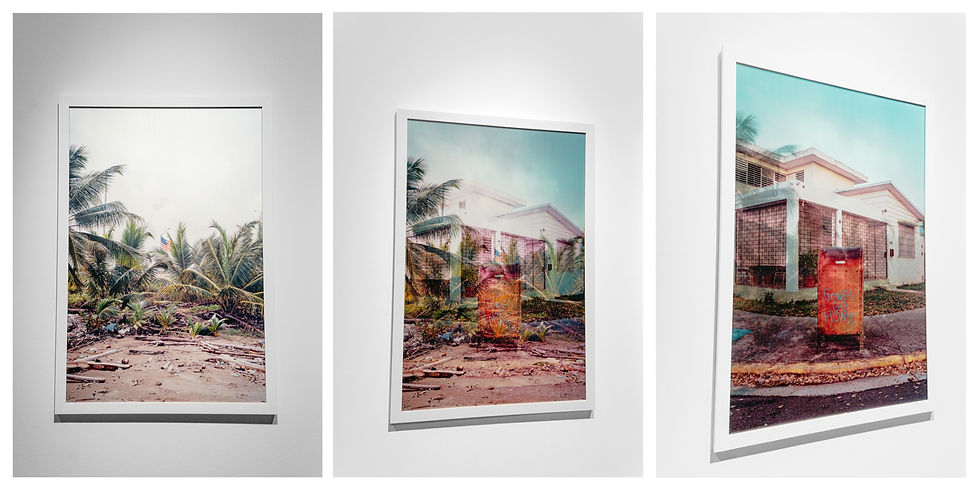
She's also quick to complicate the picture. Not every local who participates in the tourism economy is complicit by choice; many are desperate, squeezed by a colonial economic structure that left few alternatives. And Jo considers herself a tourist too, in her own way. When she visits the smaller islands around Borikén, she's careful about where she puts her money. "Even in my own country, I have to be aware."
Jo was displaced by Hurricane Maria in 2018 and has been in Seattle since. Moving to the States sharpened her lens on how people in the U.S. perceive Puerto Rico. She started noticing how little people here know about the island: that it's a colony, not a territory; that Puerto Ricans can't vote for president; that they hold U.S. passports but don't have the same access to medical insurance as people on the mainland. "People here don't know that. So I started trying to tell that story—what is actually Puerto Rico as a colony, and what it is to be from a place that is seen as a vacation resort and nothing else."

She also made a deliberate choice when she got here: she would not code-switch. She speaks Caribbean Spanish, inflected with indigenous and West African language, without accommodation. Part of it is advocacy. She noticed early that institutions weren't offering translation services and wanted to push for that. Part of it is resistance to the anti-Latino rhetoric that has made speaking Spanish in public feel dangerous. "I've been told 'speak American' here," she says. She pushes back with the obvious, "The whole continent is America. You can't tell me to speak American when Spanish is also American." She also pushes back on hierarchies within Latino communities too, where Caribbean Spanish gets looked down on. "For me to not code-switch my accent is a form of resistance for all of those reasons. It's reclaiming that."
Her installations are immersive by design. She wants people to feel the weight of colonialism, not just understand it. "While you're there, you're surviving, and you don't even notice how pulled down and traumatized you are until you're out." The work is meant to do two things at once: hold people with privilege accountable and give diasporic communities a space to feel seen. She recalls a man who came up to her after a show, a financier who had been involved in Puerto Rico's debt crisis, who told her he had learned he was wrong. "Thank you for being so honest," she told him.
For the people who already lived what she's describing, the work is different. "I want them to have a space to feel they have a community that this is a common thread in many of us. This isn't just Puerto Rico. It happens in Mexico, Thailand, Hawaii, Guam, the Philippines." She's met people from all those places at her shows. "I want them to have a space to process that with somebody else who experienced a similar thing, especially when they don't see it as often in places like Seattle."
Paradise, she insists, belongs to the people who actually live in it.

Jo has several projects coming up in Seattle. She is curating a group exhibition at SOIL Artist-Run Gallery in Pioneer Square, with an opening date on first Thursday, June 4th through June 25th. Beginning in April, she will be an artist-in-residence at Shunpike's 380 Arts Space at 380 Union St, a residency that runs through November. She is also preparing for a residency at Seattle Public Library's Central Library, where her programming will include documentary and film screenings focused on Puerto Rico, artist talks featuring practitioners from the archipelago, and community domino tournaments. Timing for the library residency is still being confirmed. Follow her on Instagram @jo.cosme for updates for where you can see her work.
Jo holds a BFA in Photography from the School of Fine Arts of Puerto Rico. Her work has been exhibited at Museo de las Américas (PR), Whatcom Museum, Photographic Center Northwest, Dab Art Gallery (Los Angeles), and Galerie Rivoli 59 (Paris). Her awards include the MASS MoCA Puerto Rican Artist Fellowship, Northwest Film Forum’s Collective Power Fund Grant, Artist Trust’s GAP Grant, Pratt Fine Arts Center’s Bernie Funk Scholarship, McMillen Foundation Fellowship, and 4Culture’s Arc Fellowship. In 2025, she presented new work at Gallery 110 and ARTS at King Street Station with her show, Welcome to Paradise: ¡Viva Puerto Rico Libre!, which you can watch a tour of below.


